August 5, 2006, Ulaan Bataar, Republic of Mongolia
Morning.
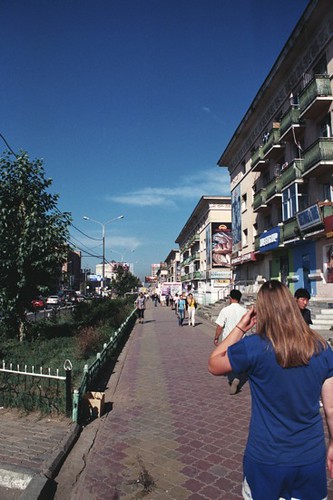
A nice brisk and sunny morning greets us in UB. As I wake up from my bed I think to myself that I slept a lot better in this place than our previous one. But alas, that was yesterday; today is today. Let’s get breakfast!
Andy, Lili and I walk over and down across from the SDS to Michele’s French Bakery (Yes it is owned by a French guy named Michele). As a side note, there are several types of restaurants to be found in UB. In our stay we ate at an American, a Mexican, a Mediterranean, an Italian, a Korean, a Mongolian(yes of course) restaurant. They were all surprisingly authentic in their own ways. But I digress… Michele’s French Bakery is a small establishment, which seems to seat up to 20 patrons. Upon entering one can instantly smell the scent of freshly baked products. We sit at the first table and grab a menu. I order an espresso and a ham and cheese croissant. They are good and for a moment I have to look around to make sure of where I am again. Oh yes Mongolia! Michele’s French Bakery caters mostly to tourists who are seeking a quick energy boosting breakfast before trekking into the countryside. We were not one of them, we were going to the Black Market today.
After breakfast Lili strays off to say her last goodbye to her group, while Andy and I hailed a cab and head to the Black Market. A note about cabs here. In UB any car is a potential cab. “How could that be?” You ask. Well basically taking a cab is sometimes a form of paid hitchhiking. The few licensed cabs in town have rated meters. The rest, well that’s up to the driver, but sometimes you get a better deal without the meter as they seem to spew out random numbers. Anyways, Andy and I hopped into a metered cab en route to the market. At arrival our total cost was around 3,000 Tugriks. Not bad we thought and out we were in front of the entrance to the grand and famed Black Market. I don’t have a picture of it except in my mind since I did not dare take my camera in there. We had heard stories. Specifically, one of Lili’s kids had been robbed at knifepoint just days earlier. We approach enthusiastically but yet with a sense of caution.
We are alowed to enter the Black Market after purchasing a 50 Tugrik ticket. That’s less than 5 cents! Wow! I that feel the bargain hunting has begun! So our list is pretty simple and basic. We need camping gear. You know, tents, sleeping bags, cups, dishes, etc… Walking around the small open-air and vinyl-walled “stores” we see all types of products. From slippers to radios to hats to pens and all sorts of things we don’t need. So naturally I approach one of the local sales persons to inquire about sleeping bags. Now my Mongolian Phrase book, given to me in Beijing by the hotel’s bartender, will be of great use… I think so optimistically. It takes about 10 minutes for them to decipher that we are looking for sleeping bags. A nice old lady beckons to follow her. “Is this a trap?” I think to myself, not wanting to alarm Andy. But the lady has a friendly smile, not the friendly type on evil people, but friendly like good family folk. So we follow her and surely enough she leads us through the market maze to the sleeping bag “store.” Excellent! We made out with sleeping bags and mats for under 20 US dollars each. Jackpot! Now we tread on to find the other stuff, but it is unfound. Blast!
We leave the Black Market with sleeping bags at least. On the side of the road I watch after our bags while Andy sticks out his hand in the universal cab/hitchhiker signal. Not as quickly as anticipated but soon a red unkempt Hyundai, which resembles an old horse waiting to die, pulls up and we enter. Andy points to our trusty map to indicate our destination, the SDS, while I notice we have taken service from one of those non-metered cabs. This shall be interesting. The driver crunches the shift stick into gear and the “horse” roared off with a moan. The old steed seems to not want to go anywhere, but to where ever it is that cars go to die. At each traffic light, there were a total of four, the machine collapses with a shake. The driver unresistingly wiggles and turns the key kicking the contraption back into life. And off it goes, hesitantly. All along the driver smiles and seems to be having a great day. Even at the end of our journey, when the beast refuses to let me out, the driver just smiles and nudges on the handle magically opening the exit. Total price about half as much as the previous metered cab had cost.
Tonight we dine Mediterranean and I try some Chinggis Vodka.
Morning.
A nice brisk and sunny morning greets us in UB. As I wake up from my bed I think to myself that I slept a lot better in this place than our previous one. But alas, that was yesterday; today is today. Let’s get breakfast!
Andy, Lili and I walk over and down across from the SDS to Michele’s French Bakery (Yes it is owned by a French guy named Michele). As a side note, there are several types of restaurants to be found in UB. In our stay we ate at an American, a Mexican, a Mediterranean, an Italian, a Korean, a Mongolian(yes of course) restaurant. They were all surprisingly authentic in their own ways. But I digress… Michele’s French Bakery is a small establishment, which seems to seat up to 20 patrons. Upon entering one can instantly smell the scent of freshly baked products. We sit at the first table and grab a menu. I order an espresso and a ham and cheese croissant. They are good and for a moment I have to look around to make sure of where I am again. Oh yes Mongolia! Michele’s French Bakery caters mostly to tourists who are seeking a quick energy boosting breakfast before trekking into the countryside. We were not one of them, we were going to the Black Market today.
After breakfast Lili strays off to say her last goodbye to her group, while Andy and I hailed a cab and head to the Black Market. A note about cabs here. In UB any car is a potential cab. “How could that be?” You ask. Well basically taking a cab is sometimes a form of paid hitchhiking. The few licensed cabs in town have rated meters. The rest, well that’s up to the driver, but sometimes you get a better deal without the meter as they seem to spew out random numbers. Anyways, Andy and I hopped into a metered cab en route to the market. At arrival our total cost was around 3,000 Tugriks. Not bad we thought and out we were in front of the entrance to the grand and famed Black Market. I don’t have a picture of it except in my mind since I did not dare take my camera in there. We had heard stories. Specifically, one of Lili’s kids had been robbed at knifepoint just days earlier. We approach enthusiastically but yet with a sense of caution.
We are alowed to enter the Black Market after purchasing a 50 Tugrik ticket. That’s less than 5 cents! Wow! I that feel the bargain hunting has begun! So our list is pretty simple and basic. We need camping gear. You know, tents, sleeping bags, cups, dishes, etc… Walking around the small open-air and vinyl-walled “stores” we see all types of products. From slippers to radios to hats to pens and all sorts of things we don’t need. So naturally I approach one of the local sales persons to inquire about sleeping bags. Now my Mongolian Phrase book, given to me in Beijing by the hotel’s bartender, will be of great use… I think so optimistically. It takes about 10 minutes for them to decipher that we are looking for sleeping bags. A nice old lady beckons to follow her. “Is this a trap?” I think to myself, not wanting to alarm Andy. But the lady has a friendly smile, not the friendly type on evil people, but friendly like good family folk. So we follow her and surely enough she leads us through the market maze to the sleeping bag “store.” Excellent! We made out with sleeping bags and mats for under 20 US dollars each. Jackpot! Now we tread on to find the other stuff, but it is unfound. Blast!
We leave the Black Market with sleeping bags at least. On the side of the road I watch after our bags while Andy sticks out his hand in the universal cab/hitchhiker signal. Not as quickly as anticipated but soon a red unkempt Hyundai, which resembles an old horse waiting to die, pulls up and we enter. Andy points to our trusty map to indicate our destination, the SDS, while I notice we have taken service from one of those non-metered cabs. This shall be interesting. The driver crunches the shift stick into gear and the “horse” roared off with a moan. The old steed seems to not want to go anywhere, but to where ever it is that cars go to die. At each traffic light, there were a total of four, the machine collapses with a shake. The driver unresistingly wiggles and turns the key kicking the contraption back into life. And off it goes, hesitantly. All along the driver smiles and seems to be having a great day. Even at the end of our journey, when the beast refuses to let me out, the driver just smiles and nudges on the handle magically opening the exit. Total price about half as much as the previous metered cab had cost.
Tonight we dine Mediterranean and I try some Chinggis Vodka.