August 3, 2006, Dornogovi Province, Republic of Mongolia
Morning.
 The sun’s rays wake me at 6:00 AM, and I feel very thirsty. I pick my self out of bed and look to the bunk above me. Andy is fast asleep. I look out the window and pause in awe at the sight before me. All I can see, for as far as I can see, is a terrain covered with bright orange sand. The sand is everywhere. In fact, it is inside the train cabins and in my nose as well. That would explain the dehydration. I remember someone telling me this would be the case. It was probably Michael during one of our Extrarefreshments.
The #3 Express is running two and half hours late as a result of our border crossing delay. This doesn’t affect me as I stand in the hall admiring the outdoors through the windows. I don’t recall how much time goes by until Andy wakes up, but he interrupts my daze and we continue to the bar car for breakfast. A newly decorated car has been exchanged for the previous one. It has fantastic carved wooden panels with swords and arrows hanging on the walls. A nice Mongolian welcome. Andy and I sit and order the only thing on the menu: Fried eggs, toast and a glass of tea. This is the most expensive meal we will ever have on the trip.
 Shortly after breakfast the train stops at a small town in the middle of the Gobi. We step out and are greeted by dozens of children selling cookies and bottled water. I imagine that every time a train stops the whole town comes to the station to make a little spare change. Andy buys one bottle and verbally struggles for his change as I wander off to take some pictures. There are probably up to 30 houses in my view, and beyond that pure golden desert. How must it be to live here? I won’t find out. The conductor calls out and we hop back on the train. The train idles onward towards the north.
I have been traveling by train for over 24 hours. It surely beats any amount of time on a plane, but I will happily say goodbye to the #3 before sundown. I cannot fathom staying on the train for the entire trip to Moscow. Some of my fellow passengers are doing just that and will only experience Ulaan Baatar for about 15 minutes and no more. This will be true for all the stops they shall make until reaching the Russian capital. I await a warm shower and a comfortable bed.
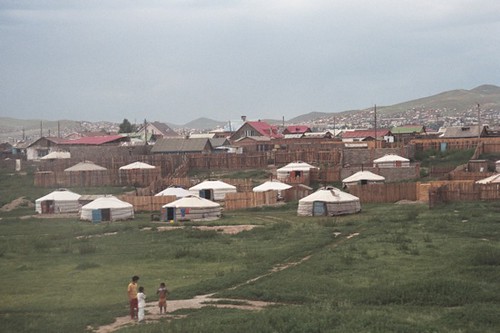
It is 4:00 PM and the train is curving through rolling hills. The topography has changed to a darker tanned soil speckled with green bushes. We must be getting near. I can just picture Ulaan Baatar appearing over one of these hills. And it does, after about 20 of them. It is a large city spread over a vast valley. There are no tall buildings or structures but I can make out the tall cooling towers from one of its four coal power plants: Power Plant #3. Nearing the city I notice that the city is composed not only of fixed concrete buildings but also of portable canvas gers that sprinkle the outskirts. I begin to get that anxious feeling to get off the train and begin exploring.
 The train halts at the station. Andy and I gather all of our belongings and step off the train for one last time. The day is sunny but the air is cool and dry, and it should be at 1600 meters above sea level. We try to find our friend Michael who was stepping out with his group for a weekend in Ulaan Baatar before catching a different train onwards, but they get lost in the hoard of people awaiting relatives and shipments. Andy and I continue to the exit to find our friend’s driver, which should be waiting near the “Big TV.”
Sure enough, there is a big screen at the entrance to the station and I catch a glimpse of a man holding up a sign with our names on it. I greet him and he helps us place our belongings in the car. I approach the right side of the car, thinking I would sit in the front passenger side, but I find the driver beats me to it. He opens the door and I discover a steering wheel. I look across to the left side and find none. This confuses me since people are driving on the right side of the road, but I find out later that a lot of cars come from Japan. So you have a city where drivers drive on the right side of the road but can opt to ride on the left or right of their cars. Brilliant! Maybe…
Communication with the driver is nonexistent as my Mongolian is as good as his English. He drives to a hotel near the station that has been arranged for us. The Jiguur Grand Hotel on Chinggis Khann ave. appears very decent, with advertised Internet and spa. This is a lot more than we needed at a price that was a little above our budget. We decide to stay the night but scout other options downtown. We leave our belongings and the driver takes us to meet our friend and an interpreter to negotiate prices for our trip. This would be the first of several meetings with several people. Our adventure had just begun.
Morning.
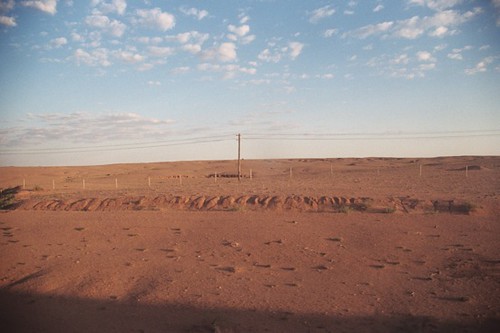 The sun’s rays wake me at 6:00 AM, and I feel very thirsty. I pick my self out of bed and look to the bunk above me. Andy is fast asleep. I look out the window and pause in awe at the sight before me. All I can see, for as far as I can see, is a terrain covered with bright orange sand. The sand is everywhere. In fact, it is inside the train cabins and in my nose as well. That would explain the dehydration. I remember someone telling me this would be the case. It was probably Michael during one of our Extrarefreshments.
The #3 Express is running two and half hours late as a result of our border crossing delay. This doesn’t affect me as I stand in the hall admiring the outdoors through the windows. I don’t recall how much time goes by until Andy wakes up, but he interrupts my daze and we continue to the bar car for breakfast. A newly decorated car has been exchanged for the previous one. It has fantastic carved wooden panels with swords and arrows hanging on the walls. A nice Mongolian welcome. Andy and I sit and order the only thing on the menu: Fried eggs, toast and a glass of tea. This is the most expensive meal we will ever have on the trip.
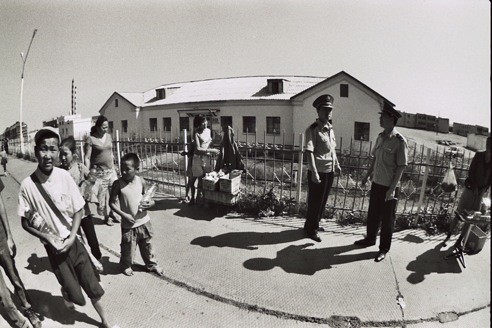 Shortly after breakfast the train stops at a small town in the middle of the Gobi. We step out and are greeted by dozens of children selling cookies and bottled water. I imagine that every time a train stops the whole town comes to the station to make a little spare change. Andy buys one bottle and verbally struggles for his change as I wander off to take some pictures. There are probably up to 30 houses in my view, and beyond that pure golden desert. How must it be to live here? I won’t find out. The conductor calls out and we hop back on the train. The train idles onward towards the north.
I have been traveling by train for over 24 hours. It surely beats any amount of time on a plane, but I will happily say goodbye to the #3 before sundown. I cannot fathom staying on the train for the entire trip to Moscow. Some of my fellow passengers are doing just that and will only experience Ulaan Baatar for about 15 minutes and no more. This will be true for all the stops they shall make until reaching the Russian capital. I await a warm shower and a comfortable bed.
It is 4:00 PM and the train is curving through rolling hills. The topography has changed to a darker tanned soil speckled with green bushes. We must be getting near. I can just picture Ulaan Baatar appearing over one of these hills. And it does, after about 20 of them. It is a large city spread over a vast valley. There are no tall buildings
 or structures but I can make out the tall cooling towers from one of its four coal power plants: Power Plant #3. Nearing the city I notice that the city is composed not only of fixed concrete buildings but also of portable canvas gers that sprinkle the outskirts. I begin to get that anxious feeling to get off the train and begin exploring.
 The train halts at the station. Andy and I gather all of our belongings and step off the train for one last time. The day is sunny but the air is cool and dry, and it should be at 1600 meters above sea level. We try to find our friend Michael who was stepping out with his group for a weekend in Ulaan Baatar before catching a different train onwards, but they get lost in the hoard of people awaiting relatives and shipments. Andy and I continue to the exit to find our friend’s driver, which should be waiting near the “Big TV.”
Sure enough, there is a big screen at the entrance to the station and I catch a glimpse of a man holding up a sign with our names on it. I greet him and he helps us place our belongings in the car. I approach the right side of the car, thinking I would sit in the front passenger side, but I find the driver beats me to it. He opens the door and I discover a steering wheel. I look across to the left side and find none. This confuses me since people are driving on the right side of the road, but I find out later that a lot of cars come from Japan. So you have a city where drivers drive on the right side of the road but can opt to ride on the left or right of their cars. Brilliant! Maybe…
Communication with the driver is nonexistent as my Mongolian is as good as his English. He drives to a hotel near the station that has been arranged for us. The Jiguur Grand Hotel on Chinggis Khann ave. appears very decent, with advertised Internet and spa. This is a lot more than we needed at a price that was a little above our budget. We decide to stay the night but scout other options downtown. We leave our belongings and the driver takes us to meet our friend and an interpreter to negotiate prices for our trip. This would be the first of several meetings with several people. Our adventure had just begun.